
New Year, new controversy. If you thought 2025’s legal controversies would be left behind, then you are certainly wrong.
Oh boy, would you look at that! If you thought 2025’s Armageddon of controversy and censorship issues in anime and manga would be left behind, well, friend, smell the coffee because this stuff ain’t leaving anytime soon. So, what’s going on this time? More censorship, or controversy in the community? Well, you could say both. Since last year, there’s been a rampant attack not just on anime and manga, but on the internet as a whole—ranging from age verification laws, to restrictions on certain freedoms of expression, and corruption in the free market. Most specifically, banks and credit card companies have been exposed for refusing payments and services to select individuals or platforms unfairly deemed problematic. The latest incidents are yet another example of this sad continuation of censorship.
MangaDex, one of the most well-known piracy sites for manga, recently announced that it has removed certain manga titles from its website to comply with the law and avoid legal troubles with officials. The question you’re probably asking is: what exactly did MangaDex remove?
Well, according to recent reports, the titles that MangaDex removed were mainly lolisho content that specifically focused on obscene activity between underage characters—either through their official character age or simply because they look like minors despite being officially adults in their character database.
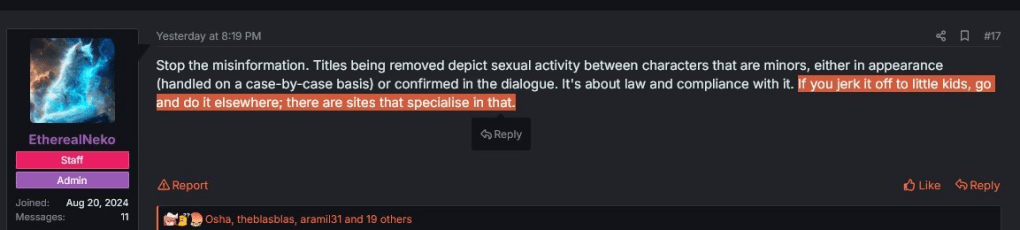
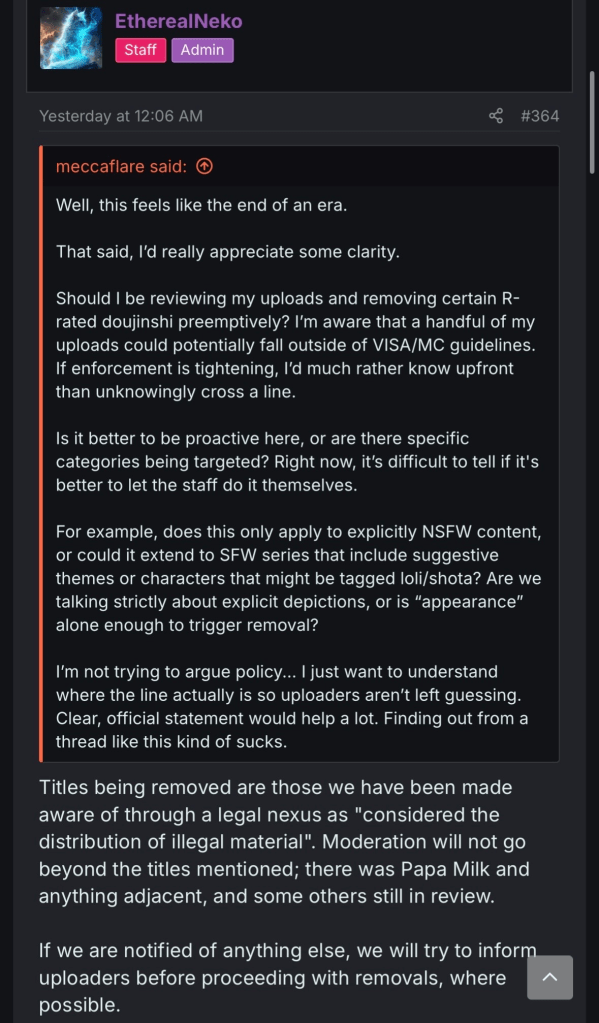
According to more reports, EtherealNeko, one of the admins for MangaDex, stated that this recent move comes in accordance with UK law, as their registration is specifically incorporated in the UK. According to UK law, depictions of fictional underage characters in sexual contexts can fall under strict obscenity laws, even if no real minors are involved.
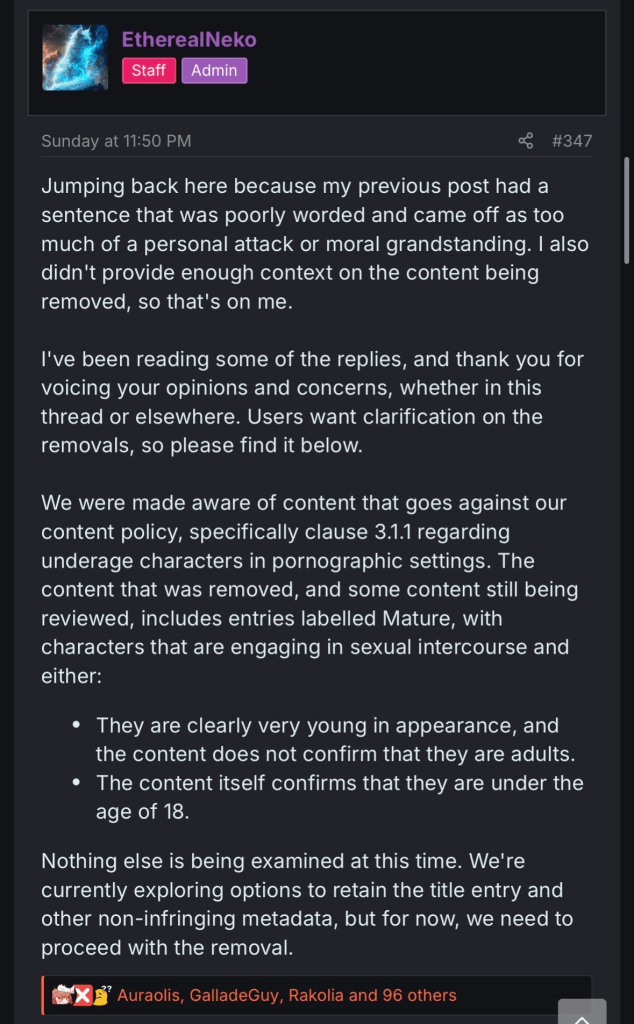
Recently, MangaDex has reportedly filed trademark and company registration steps in the UK around August 2025. This perhaps has been part of the reason why MangaDex initiated this move.
More details were given regarding the removal of specific content deemed in violation of the law. The removals target Mature-labeled entries with explicit sexual intercourse scenes where characters:
- Appear clearly very young without adult confirmation, or
- Are explicitly stated/under 18 in the content.
According to MangaDex, it is not a “blanket ban” on loli tags or non-explicit content. MangaDex also reassured its users that its website is not on a moral crusade, but defended their actions and called it a legal necessity. They also suggested that users who want the already removed content should seek it elsewhere.
However, as the saying goes: give the government an inch, and they’ll take everything from you. How is the backlash, you ask? Well, as expected, there was major roaring anger from users who rely on MangaDex for reading manga online for free. Concerns range from fears over the removal of 18+ manga/doujin content that doesn’t feature violating material. Some fear it could remove over half of that content from the entire website. Others have also accused staff members of virtue signaling and acting on personal bias—notably citing the admins’ harsh responses to the criticism they’re receiving.
Notably, some users are now starting to believe that MangaDex may be taking the Crunchyroll and Fakku route. What do I mean? As we all know, MangaDex is a piracy website, as the site itself is not in legal compliance with official law regarding copyright and licensing of property from official companies, whose manga content is part of their official intellectual property. Prior to the mentioned website’s changes, Crunchyroll was an illegal anime streaming website between 2006 and 2009. Notably, Crunchyroll hosted numerous popular anime on their streaming site, which even received denouncement from official licensing companies such as Funimation (ironically now known as Crunchyroll dubs) at the time. Eventually, in January 2009, Crunchyroll transitioned to a legal streaming service and effectively removed all pirated content from their website. Similarly, Fakku, founded in 2006, was also a pirated website for hentai manga and lasted for eight years (2006–2014) as the magnum opus of pirated content for 18+ manga. However, in 2015, the company transitioned to a legal licensing website for hentai manga and partnered with numerous official companies from Japan, such as Wanimagazine, thus removing all pirated content. The changes from both companies caused a chain reaction of dedicated fan users who contributed to the sites leaving to search elsewhere.
It is theorized that MangaDex may be taking the official legal route as a way to grow the company bigger. As MangaDex is notable for being the biggest manga piracy website for reading manga, the company and the masterminds behind it may be abandoning the fan-based community for a more commercial, free-for-all website with its lineup of manga. This would aim to appease the normal crowd and remove content deemed problematic, which could effectively harm future plans for a more legalized, professional brand that seeks partnerships and sponsors.
This isn’t the first time that MangaDex has been under fire. Last year, MangaDex suffered the worst DMCA takedown ever, which many users described as unprecedented: at least 7,000 titles were removed from the website following actions from companies such as Square Enix and Kodansha. To make matters worse, some rare and obscure manga titles that could only be read on MangaDex were removed, thus forcing readers to look elsewhere to continue reading them. This incident didn’t kill the website, but it certainly harmed their arsenal of libraries that were popular among readers.
Okay, so I will be giving you my honest and blunt opinion. First off, if you think my rant is going to be about me yapping on about how angry I am that lolisho content was removed from MangaDex because I identify as a lolicon and I love “muh lolis,” then don’t. Why? Because the truth is, I couldn’t give a rat’s backside about lolisho content—I utterly despise the trope itself. I never liked lolisho; I always disliked it even when I first got into anime and manga in the late 2000s and early 2010s, and whenever I see it, I just can’t stand it. My rant isn’t about the lolisho content being removed.
My rant is about the blunt moral double standards and hypocrisy behind MangaDex’s reasons for removing such content. They claim it’s to comply with the law, but hear me out: MangaDex isn’t complying with the law in the first place anyway. I just find it so hypocritical and two-faced that a website like MangaDex is literally using a virtue-signaling reason to justify removing lolisho content from their site in the name of legal compliance and moral justification—when the website itself is already breaking the law and causing harm in its own right. This is such a hypocritical stance that, honestly, it’s like a politician who goes on and on about how new laws should make us “think of the children,” and then screws over taxpayers, steals money from their hard-earned jobs, and funnels it into lining their own pockets with stolen goods. Oh wait, what am I talking about? THAT IS HAPPENING IN REAL LIFE!
MangaDex is not an official licensing website for manga. They host manga titles on their website using unauthorized methods. Until recently, MangaDex ignored complaints and warnings over and over again from official companies and copyright protection entities such as those issuing DMCA notices. Every time you read a manga online from MangaDex, without realizing it, the manga industry gets harmed and loses out on potential profits. Now, of course, it’s not your fault because—let’s be darn honest here—the manga industry refuses to make it easier for readers around the world to have easy, direct access to reading manga from Japan, covering almost any title one would like to read, whether modern, old, mainstream, or niche. The issue isn’t so much about that; it’s more about how suddenly MangaDex wants to classify itself as a group that is now obeying the law in good faith for moral reasons. How can one justify using that reason when the act of piracy is still in play? Replacing obscene content deemed necessary to protect minors while still hosting unauthorized content—through the use of someone else’s creative hard work—is definitely not the moral high ground flex that MangaDex should be bragging about.
If there is one thing I will talk about regarding content, it’s not in defense of lolisho—it’s the dangers of a slippery slope that eventually gives the higher-ups full authority and power to deem what content is suitable and available for public readers, as long as they give it the green light. Look, the truth is, I don’t want to go on and on repeating the same thing over and over again, as you already know what my answer will be. Implement anti-lolisho policies, and watch how even the most mainstream and well-known manga titles in the world—such as Berserk, Dragon Ball, and Demon Slayer—will be targeted because they now have the authority to deem them dangerous, obscene material for children. Don’t believe me? Go look at what happened in Texas, where a library had to remove Dragon Ball due to fears of legal problems, and how San Japan had to remove JAST from the convention because of legal issues—despite no minors being involved at all. Do you see the freaking stupidity here? The people who make these laws clearly have NEVER watched anime, read manga, or engaged with animation and drawings in general, because many of them still cling to this stupid conservative belief that it’s only for children. It’s even more saddening how MangaDex has to virtue-signal with such a failed reason. Fun fact: not all so-called “lolisho” manga have been removed. Because guess what? Only the famous and well-known ones with a mainstream following, and borderline lolisho content with an actual “loli” tag—like Konosuba and Eromanga Sensei—are still available to read! Wow, would you look at that! I wonder why? Because money talks! Follow the money and you’re excused from everything! Pfft, what a joke…
Either way, I’m disappointed with the current news regarding MangaDex, but at the same time, I’m really not surprised… Since the start of the 2020s, this has all but become far too common. Gee, I wonder what else will happen next? All I can say is, yeah, it’s completely okay to hate lolisho—because I do—but when you give political figures and government officials full power, then the power of censorship will be used to attack all other creative content elsewhere in the name of enforcing a narrative they deem necessary to control.
After all, justice was served with the Epstein files, right…? RIGHT?
Thanks for reading my fellow otakus! Don’t forget to like, share, follow, and check out my socials!
 Animangemu
Leave a comment