New Year, new controversy. If you thought 2025’s legal controversies would be left behind, then you are certainly wrong.
Oh boy, would you look at that! If you thought 2025’s Armageddon of controversy and censorship issues in anime and manga would be left behind, well, friend, smell the coffee because this stuff ain’t leaving anytime soon. So, what’s going on this time? More censorship, or controversy in the community? Well, you could say both. Since last year, there’s been a rampant attack not just on anime and manga, but on the internet as a whole—ranging from age verification laws, to restrictions on certain freedoms of expression, and corruption in the free market. Most specifically, banks and credit card companies have been exposed for refusing payments and services to select individuals or platforms unfairly deemed problematic. The latest incidents are yet another example of this sad continuation of censorship.
MangaDex, one of the most well-known piracy sites for manga, recently announced that it has removed certain manga titles from its website to comply with the law and avoid legal troubles with officials. The question you’re probably asking is: what exactly did MangaDex remove?
Anime’s popularity has tremendously grown in recent years, but, behind that growth left behind a backdoor that has become rife within the community.
For the longest time, the global popularity of anime and manga has continued to rise dramatically. Our medium has become so mainstream and beloved that it’s no longer uncommon to encounter fellow fans almost anywhere. This holds true not only in sparsely populated regions of the United States, but even in countries around the world that have little to no historical or cultural ties to Japan and where the market for anime and manga remains relatively small.
Of course, like all interests, new fans naturally enter fandoms as their popularity grows. When newcomers arrive, controversy often follows, and longtime members frequently take issue with the “hot takes” these newcomers share. These opinions might concern quality judgments, preferences between modern and classic favorites, or challenges to the common practices and core beliefs that the older community has established—especially when those views clash with what the creators of the series themselves believe in.
As we all know, anime and manga are no exception to this pattern. The medium continues to experience unprecedented global growth, expanding the fandom dramatically. But the key question remains: Is this rapid growth ultimately good for anime and manga?
Lately, there has been a wave of controversy in the anime community. What exactly is this controversy about? It centers specifically on the influx of newer anime and manga fans. At first glance, this might seem like the typical case of gatekeeping in a fandom. However, as you take a closer and deeper look into the issue, you’ll see that this controversy is actually a bigger problem than most people realize. It even has its own official name: anime tourism (often shortened to “anime tourist” as a pejorative label). So, what exactly is “anime tourism”?
And all of the glory goes to the Almighty God above the beautiful heavens. Thank You, my Holy Father, for bringing this beautiful passion of mine back to life. What you just read isn’t merely an anniversary reflection—it’s a living testimony from me. This wasn’t just some random story that happened. It was a beautiful promise given to me by my Almighty God, foretelling good news that would come into my life, and in the end, it did happen—exactly as He said it would. Every single paragraph, every action, every turning point, every moment of heartbreak and rebirth… all credit, all praise, and all glory belong to Him alone—the Almighty God of Glory! Amen! – Kurai
On December 20, 2015, in the 87th minute of a Serie A match between Inter Milan and Lazio at the San Siro, Felipe Melo conceded a penalty with a reckless challenge on a cold late-autumn afternoon. Antonio Candreva stepped up and calmly converted the spot-kick, restoring Lazio’s lead. In the end, Lazio claimed the three points they desperately needed, leaving the San Siro stunned. Among those stunned was me—a passionate, 18-year-old Inter supporter watching from across the Atlantic in the Sunshine State. It was a typical gray, cold, cloudy day in the suburbs of Orlando. In a surge of rage, disappointment, and sheer exhaustion from years of constant Nerazzurri heartbreak, I hurled my slipper to the ground.
That moment crystallized something for me: the Nerazzurri were going to disappoint their faithful once again. After years of mediocrity—and with more to come—Inter had a well-earned reputation for spectacular collapses after crucial defeats like this one. Sure enough, the team imploded. They fell from 1st place to 4th by January, were out of the title race by March, and had dropped out of the Champions League qualification spots by May. It was a collapse so predictable it almost felt scripted. After that Lazio loss, I finally realized: enough is enough. I was tired of getting so worked up and heartbroken over something that, deep down, wasn’t even a true passion of mine anymore. I was tired of the stress, the anger, and the emotional rollercoaster over something that ultimately had very little real significance in my life. Most of all, I was tired of wasting time on a hobby that no longer brought me joy—time I could be spending on something I truly loved and wanted to build a future around. When those feelings finally surfaced, only one thing came to mind: anime, manga, and the otaku life I had once embraced so fully. After years of drought, with that passion lying dormant, something awakened inside me. I told myself: Kurai, it’s time to change course. Enough is enough. Stop wasting your energy on a team of billionaires living their dreams on the pitch, and start chasing your own. A few days later, on December 25, 2015, I began watching Attack on Titan. I finished the season on December 30.That week marked the moment I finally turned the page.
The question you’re probably asking is: what the heck does this have to do with anime, manga, and my otaku life? Well, please sit back, buckle up, and get ready—because this is the story of one of the most important turning points in my life. It’s exactly how my passion for anime and manga came roaring back. I first became an otaku in 2011, but between 2012 and 2015, I went through a long, slow drought. My enthusiasm faded, and I found myself feeling more miserable, depressed, and completely unable to take my otaku passion to new heights—the way you see me doing today, and the way I did for years after my revival began in 2016. In this piece, I’m going to tell you the full tale of how it all happened: how one small, unexpected moment brought me, as an otaku, back to life and led me to where I am today.
My fellow otakus, I’m pretty sure you have noticed that this issue has now become a pattern. Censorship after censorship, it seems like this issue never stops. Since the start of this year, there’s been a reckless attack on freedom of speech, freedom of creativity, and freedom of the internet. The excuse? Porn… Yep… Pornography!!! Since the start of 2025, there’s been a crusade against pornographic material on the internet. The same reason is always used, “think of the children!”. It first started this year in Texas, and now, state after state, the issue gets worse. As you all know, anime and manga rely heavily on the internet for basically everything. Watching, reading, games, community, fan art, etc. In other words, aside from engaging in real life social events, depending in which state you’re living in, the internet is another important place for otakus to invest time engaging with what they love. Unfortunately…
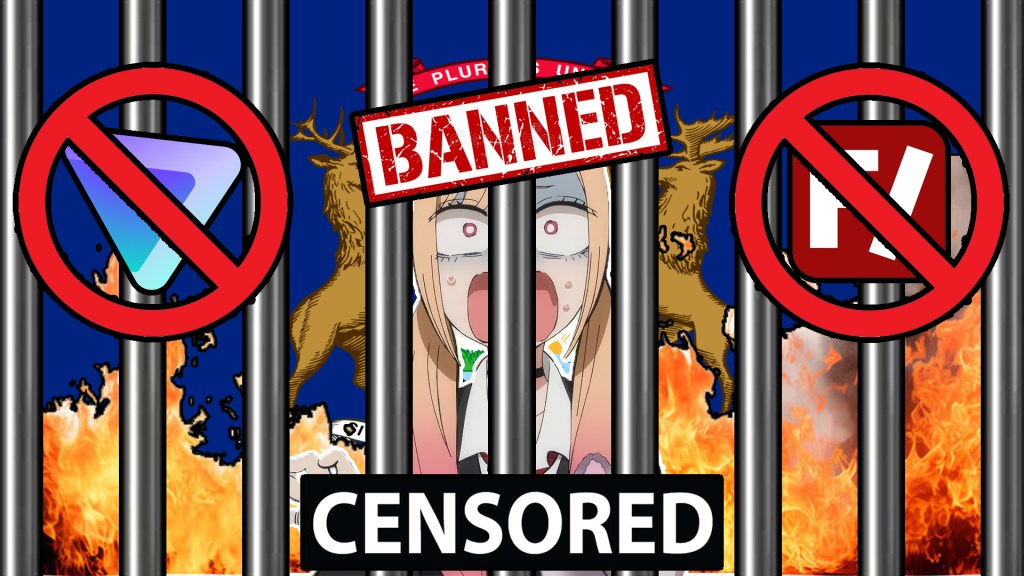
A new bill in Michigan is being proposed. What is this bill, you ask, of? Well, this bill, is what Texas is already doing, but literally on steroids… Yes, otakus in The Great Lakes State are about to get rocked by something unexpected from an unlikely law proposed by lawmakers in Michigan… The shocking part is… Manga is, LITERALLY, mentioned in this new bill. Here’s what’s going on!
Earlier this year, I spoke about the new controversial senate bill that threatens anime, manga, and video games in the state of Texas. That bill, Senate Bill 20, was a bill that passed through both the senate and house in the Texas Legislator. Then, it was signed by governor Gregg Abbott at the governor’s mansion. Since then, the law has been passed and has been in effect since September 1.
The law wasn’t just trouble… It became a major problem for all otakus in Texas, since the bill itself was vague when it came to the definition of what defines as obscene material against those not of legal age. There was no pure definition or correct bases into what was considered legal or not. The worst part is, the determination of what is deemed legal or illegal is left up to interpretation. So exactly what’s senate bill 20? According to law, this is what it’s about. If you want to know more, then you may want to read my previous article about the bill.

 Animangemu